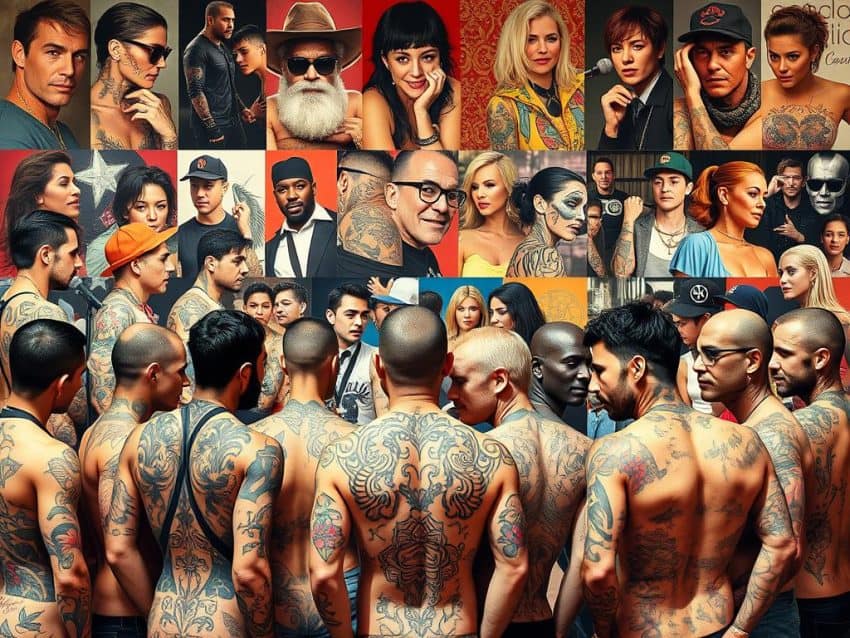
It’s amazing how something once seen as taboo can become a symbol of self-expression. I remember when I first saw a tattoo on a friend. It was like a badge of honor for her, showing stories and layers of her identity. This made me wonder why tattoos, once for the rebellious, are now everywhere.
Today, tattoos are more than a personal choice; they’re a shared statement of individuality. With nearly 30% of Americans having tattoos, and famous faces like Ed Sheeran, Rihanna, and Justin Bieber sporting them, it’s clear tattoos have made a big impact. They tell our stories, show our passions, and represent who we are.
Key Takeaways
- Tattoos have evolved from being seen as taboo to becoming mainstream art forms.
- Approximately 29% of Americans reported having at least one tattoo.
- Celebrity influence plays a significant role in normalizing tattoos in society.
- The tattoo industry is rapidly expanding, with a market worth over $3 billion in the U.S.
- Over 47% of millennials view tattoos as a vital expression of their identity.
The Historical Roots of Tattoos and Their Evolution
Tattoos have been around for thousands of years. They have deep meanings in many cultures. These meanings include spiritual significance, social status, and rites of passage.
The Ancient Practice of Tattooing
Tattooing started around 3370 BC. It’s a long-lasting way to express oneself. Ötzi the Iceman, found in the Alps in 1991, had 61 tattoos for health reasons.
Ancient Egyptians started tattooing around 2000 BCE, mainly on women. They believed tattoos brought fertility and rejuvenation. The Greek scholar Herodotus wrote about tattoos among the Thracians, Scythians, and Persians in the 5th century BCE.
From Subculture to Mainstream
In the 18th and 19th centuries, tattoos became symbols of identity and rebellion for sailors. This changed how people saw tattoos. They went from being symbols of slavery to signs of pride and individualism.
In the mid-20th century, tattoos became more accepted. This was thanks to media and celebrities. Now, tattoos are seen as art that shows personal journeys and cultural backgrounds.
Tattoos in Popular Culture: The Role of Celebrities and Media
Tattoos are more accepted today, thanks to celebrities. Stars like Justin Bieber, Rihanna, and Ed Sheeran show off their tattoos. This makes fans curious and inspired.
Seeing these tattoos in the media changes how we view them. Tattoos are now seen as a way to express oneself, not just a rebellious act.
Celebrity Influence on Tattoo Trends
Celebrities really shape tattoo trends. A survey found 70% of 18-34-year-olds see tattoos as a way to express themselves. They look up to celebrities who wear their tattoos proudly.
Also, tattooed models are in 80% of high-end ads. This shows tattoos are becoming more accepted in fashion. Celebrities sharing their tattoo stories connect with fans, leading to a 30% rise in tattoo searches online.
Impact of Reality TV and Social Media
Reality TV shows like “Ink Master” and “Miami Ink” have boosted tattoo interest by 60%. These shows not only show off tattoo art but also share personal stories. This makes viewers more engaged.
Platforms like Instagram and TikTok make tattoo trends go viral. With 25% of millennials and Gen Z sporting tattoos, body art’s acceptance keeps growing. Viral designs on these platforms start new trends, making tattoos a key part of today’s culture.
Conclusion
Tattoos have moved from a small group interest to a big part of popular culture. They mix old traditions with new trends, thanks to celebrities and media. Now, tattoos tell our personal stories, showing they’re more than just art.
Pop culture plays a big role in tattoo trends. Celebrities and TV shows inspire many designs. With 40% of adults in the U.S. having tattoos, it shows how tattoos express our identity.
Social media has changed how we see tattoos. The tattoo industry is worth over $3 billion a year. New tech, like augmented reality tattoos, shows tattoos are evolving, touching future generations.
