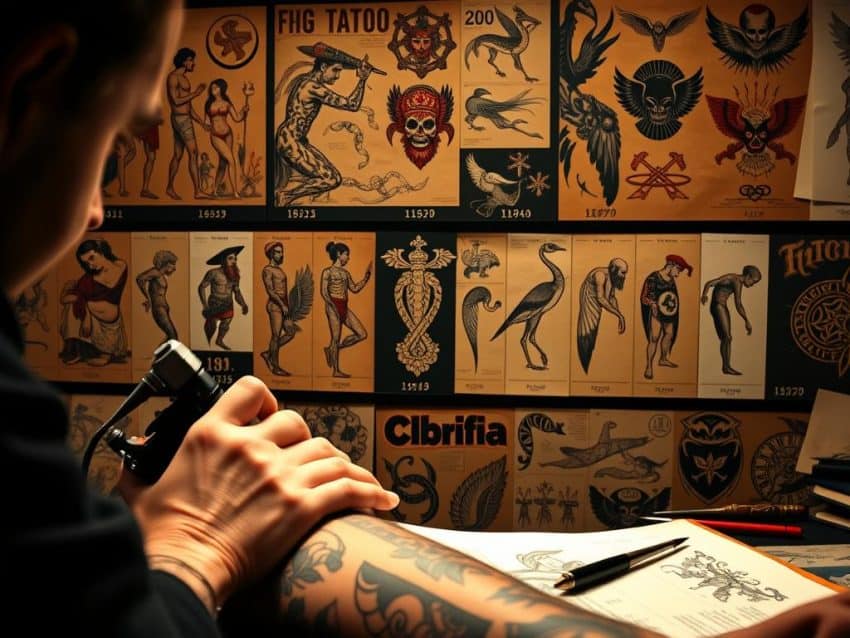
Looking at my tattoos, I often think about their history. Tattoos are more than art; they show our identity, culture, and history. The practice of tattooing goes back thousands of years to ancient times.
These ancient tattoos were not just for looks. They were deeply meaningful and part of people’s lives. Artifacts like Ötzi the Iceman remind us of our ancestors’ stories.
As we explore tattooing’s history, we see how it has changed. From ancient tools to today’s advanced techniques, tattooing has grown. Let’s look at how this art has evolved, keeping its connection to the past.
Key Takeaways
- The evidence of tattooing practices dates back to the Neolithic period, dating around 4900-4750 BCE.
- Ötzi the Iceman, with 61 tattoos, is the oldest confirmed example of a tattooed human, dating from 3370 to 3100 BCE.
- Ancient cultures utilized tattoos for various purposes, from marking achievements to indicating social status.
- Modern tattoo techniques significantly differ from ancient methods, showing advancements in tools and artistry.
- The significance and symbolism of tattoos have evolved, reflecting changing cultural perceptions over time.
Ancient Tattooing Practices
Exploring ancient tattooing shows a rich mix of art and culture that goes beyond time and place. These tattoos were more than just decorations. They held deep meanings in different societies.
Historical Origins
The oldest tattoos come from Ötzi the Iceman, dating back to about 3370 BCE. His body had 61 tattoos, mostly on his legs. This shows tattooing was common in ancient times.
Ancient Egyptians also had tattoos, starting around 2000 BCE. It’s interesting to see both men and women got tattoos. This shows different roles and societies.
Tattoo Techniques of Ancient Cultures
Different cultures used different tattooing methods. The ancient Egyptians used needles and a mix of smoke and milk for ink. Nubian tattoos had blue colors and dots, similar to Egyptian designs.
The Scythian Pazryk people had detailed tattoos of mythical creatures. Each style and technique tells a story of ancient tattoo history.
Cultural Significance of Tattoos
Tattoos had many meanings, like spiritual beliefs or social status. In Polynesian cultures, tattoos were called “tatau.” They were about identity and heritage.
In ancient China and among the Maori, tattoos were key to community identity. They marked important life events or showed belonging.
The Tattooing Process Through Time
The journey of tattooing has seen big changes, mainly in tools and techniques. From ancient times to today, tattooing has evolved a lot. This evolution has changed body art a lot.
Evolution of Tools and Techniques
The first tattoos were found on Ötzi, the Iceman, from around 3300 BC. Back then, people used simple tools like needles and sticks. Later, new tools were made, like modern tattoo machines.
These machines have many needles and can move fast. They can go from 50 to 3,000 vibrations per minute. This makes tattoos more precise and comfortable for people getting them.

In the late 1800s, electric tattoo machines came out. Samuel O’Reilly made the first electric tattoo needle in 1891. Then, the twin-coil tattoo machine came in 1899, and the rotary machine later.
These new machines made tattoos faster. Now, even big designs can be done in a few sessions, not months.
Shifts in Cultural Perceptions
How people see tattoos has changed a lot. Tattoos used to be seen as bad or rebellious. But now, they are seen as art and a way to show who you are.
Today, tattoos can be simple or very detailed. Tattoo artists are seen as talented artists, working in places that look like art galleries.
Also, taking care of tattoos has become more important. There are special products now to help keep tattoos looking good longer. This shows how tattooing has changed, not just in how it’s done but also in how society views it.
Conclusion
The history of tattoos is long and rich, showing how they’ve changed over time. From Ötzi the Iceman’s tattoos to today’s watercolor designs, tattoos have always been about self-expression. They’ve marked status and important life events in many cultures.
In our modern world, tattoos are more accepted than ever. A 2015 poll found 29% of Americans wear tattoos proudly. This shows a big change in how people view tattoos. It’s now seen as a way to express identity and art.
But, not everyone is happy with their tattoos. About 23% of people with tattoos wish they had chosen differently. Despite this, tattoos are set to keep growing in popularity. New technologies are making tattoos safer and more diverse.
The future of tattoos looks bright. New ink and machines are making it easier to create all sorts of designs. Tattoos will keep telling our stories, connecting us across generations. They’re more than just art; they’re a way to share our history and culture.
